Laravel 12 vs Laravel 13
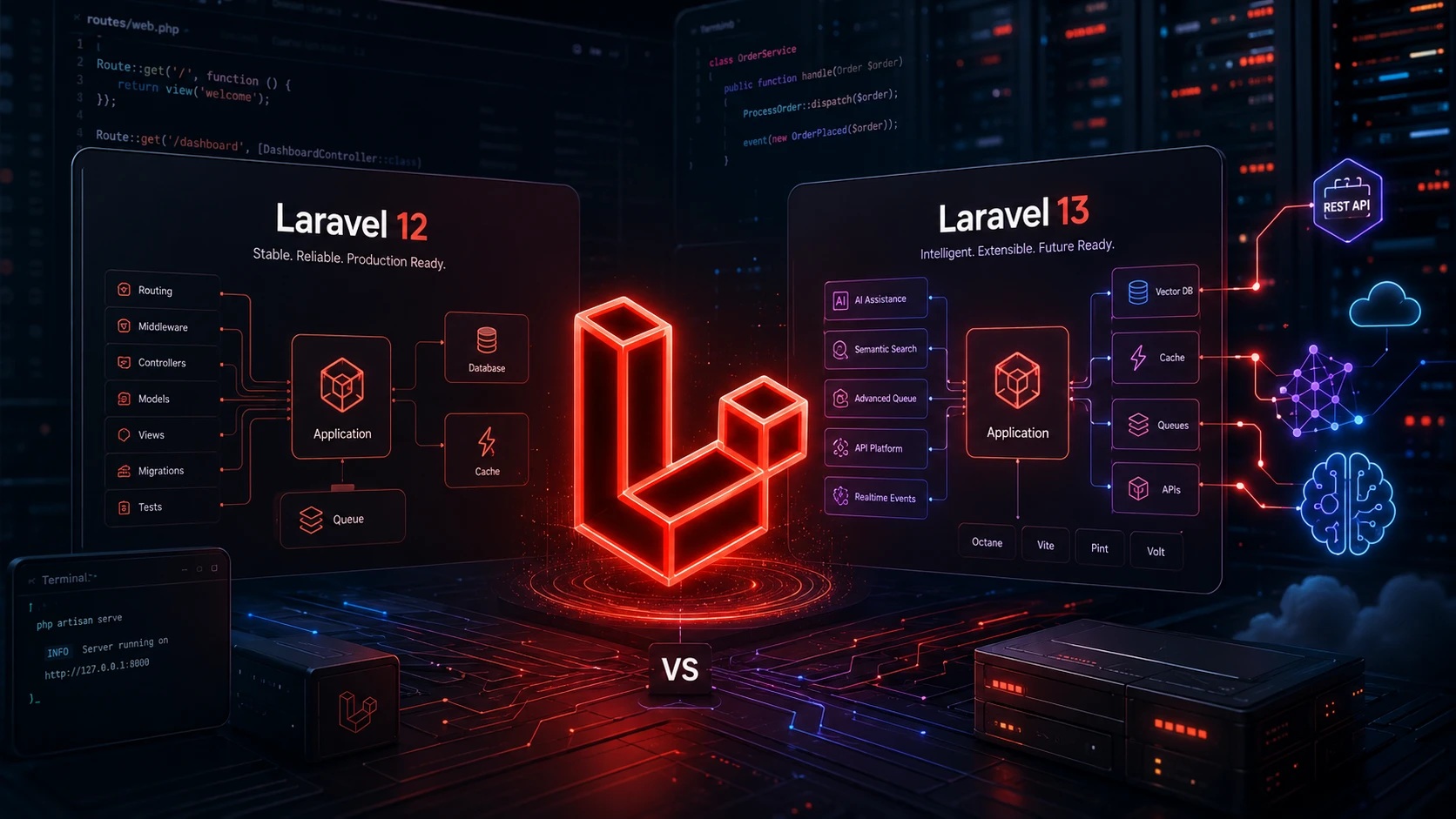
Laravel 13 is not a revolutionary release compared to Laravel 12, but it introduces several important improvements that are worth exploring for real-world applications.
If you're currently working with Laravel 12, upgrading to Laravel 13 is generally straightforward. However, before updating your projects, it's important to understand the key differences, new requirements, and features introduced in the latest version.
In this article, we'll compare Laravel 12 and Laravel 13 in terms of PHP requirements, AI capabilities, API improvements, queues, caching, attributes, and several practical code examples.
Laravel 12 Was Primarily a Stability Release
Laravel 12 continued the direction established by Laravel 11, focusing mainly on dependency updates, improved starter kits, and minimizing breaking changes.
The release introduced updated starter kits for React, Vue, Svelte, and Livewire, allowing developers to bootstrap modern applications with authentication more quickly and efficiently.
For many teams, Laravel 12 represented a stable and predictable upgrade path rather than a major architectural shift.
Some of the most significant additions include:
What Does Laravel 13 Bring?
Laravel 13 continues the framework's philosophy of minimizing breaking changes while introducing several notable features.
- PHP 8.3 as the minimum required version
- Laravel AI SDK
- Semantic Search capabilities
- Queue Routing improvements
- Broader adoption of PHP Attributes
These additions aim to make Laravel more suitable for building modern, AI-powered, and API-driven applications.
Difference #1: Minimum PHP Version
One of the most important differences between Laravel 12 and Laravel 13 is the required PHP version.
Laravel 12 supports PHP 8.2 and above, whereas Laravel 13 requires PHP 8.3 or newer.
{ "require": { "php": "^8.3", "laravel/framework": "^13.0" } }If your application is still running on PHP 8.2, you'll need to upgrade your server environment, Docker images, or local development setup before migrating to Laravel 13.
Always verify that your third-party Composer packages are compatible with PHP 8.3 before performing the upgrade.
Difference #2: Laravel AI SDK
One of the most exciting additions in Laravel 13 is the introduction of the Laravel AI SDK as a first-party solution for building AI-powered features.
In Laravel 12, integrating AI services typically required custom API integrations or third-party packages. Laravel 13 aims to provide a more Laravel-native developer experience.
use App\Ai\Agents\ContentAssistant; $response = ContentAssistant::make() ->prompt('Generate an SEO outline for a Laravel article.'); return (string) $response;The AI SDK opens the door to features such as:
- AI content generation
- Chatbots
- Text analysis
- Embeddings
- Semantic search
- Agentic workflows
For developers building modern SaaS products, this is a significant step forward.
Difference #3: Improved JSON Resources
Laravel 13 introduces improved first-party support for structured JSON responses and API development.
This is especially important for applications that expose APIs consumed by React, Vue, Next.js, or mobile applications.
In Laravel 12, developers often relied on custom serializers or additional packages to achieve consistent API structures.
use App\Models\Post; use App\Http\Resources\PostResource; Route::get('/api/posts/{post}', function (Post $post) { return PostResource::make($post); });Standardized JSON responses make APIs easier to maintain, document, and scale over time.
They also improve consistency when multiple frontend applications consume the same backend.
Difference #4: Queue Routing
Laravel 13 introduces the ability to define routing rules for queued jobs.
This allows developers to specify which queue connection and queue name should handle a particular job by default.
use Illuminate\Support\Facades\Queue; use App\Jobs\ProcessPodcast; Queue::route( ProcessPodcast::class, connection: 'redis', queue: 'podcasts' );In Laravel 12, these decisions were usually configured during dispatch or inside the job itself.
With Queue Routing, queue configuration becomes more centralized, maintainable, and easier to understand.
Difference #5: Cache and Session Prefix Changes
The Laravel 13 upgrade guide mentions changes to the default cache prefixes, Redis prefixes, and session cookie naming conventions.
While these changes won't affect every application, projects relying on framework defaults should review their configuration carefully.
// Laravel 12 Str::slug((string) env('APP_NAME', 'laravel'), '_').'_cache_'; Str::slug((string) env('APP_NAME', 'laravel'), '_').'_session'; // Laravel 13 Str::slug((string) env('APP_NAME', 'laravel')).'-cache-'; Str::slug((string) env('APP_NAME', 'laravel')).'-session'; To avoid unexpected behavior during upgrades, it's recommended to define these values explicitly in your .env file.
CACHE_PREFIX=my_app_cache REDIS_PREFIX=my_app_database SESSION_COOKIE=my_app_session
Explicit configuration reduces the risk of conflicts across multiple applications sharing the same infrastructure.
Difference #6: Broader Use of PHP Attributes
Laravel 13 استفاده از PHP Attributeها را گستردهتر کرده است. Attributeها باعث میشوند بعضی تنظیمات نزدیکتر به همان کلاس یا متدی قرار بگیرند که به آن مربوط هستند.
use Illuminate\Routing\Attributes\Middleware; #[Middleware('auth')] class DashboardController { public function __invoke() { return view('dashboard'); } }این سبک کدنویسی برای پروژههای بزرگ میتواند خوانایی را بهتر کند، چون بخشی از تنظیمات رفتاری کلاس دقیقاً کنار همان کلاس قرار میگیرد.
آیا باید از Laravel 12 به Laravel 13 ارتقا بدهیم؟
Laravel 13 expands the use of PHP Attributes throughout the framework.
Attributes allow developers to keep configuration closer to the classes and methods they affect.
use Illuminate\Routing\Attributes\Middleware; #[Middleware('auth')] class DashboardController { public function __invoke() { return view('dashboard'); } }Should You Upgrade from Laravel 12 to Laravel 13?
If your existing Laravel 12 project is stable and doesn't require the latest features, staying on Laravel 12 is perfectly reasonable.
However, if you're starting a new project or planning to implement features such as AI integrations, semantic search, advanced APIs, or improved queue management, Laravel 13 is likely the better choice.
Before upgrading a production application, make sure to review:
- Server PHP version
- Composer package compatibility
- Third-party package support
- Feature and Unit tests
- Cache, Session, and Queue configuration
- Docker and CI/CD environments
Performing a thorough upgrade assessment can save significant time and prevent production issues.
Final Thoughts
Laravel 12 primarily focused on stability, updated starter kits, and improving the onboarding experience for new applications.
Laravel 13, on the other hand, pushes the framework further toward modern, AI-enabled, and API-first application development with features such as the AI SDK, Queue Routing, Semantic Search, improved JSON tooling, and broader Attribute support.For existing Laravel 12 projects, upgrading to Laravel 13 is generally straightforward, provided that PHP versions and package compatibility are carefully reviewed.
For new applications, Laravel 13 represents a more future-oriented choice—especially if you plan to build advanced APIs, AI-powered features, or sophisticated queue architectures.