What to Learn and in What Order
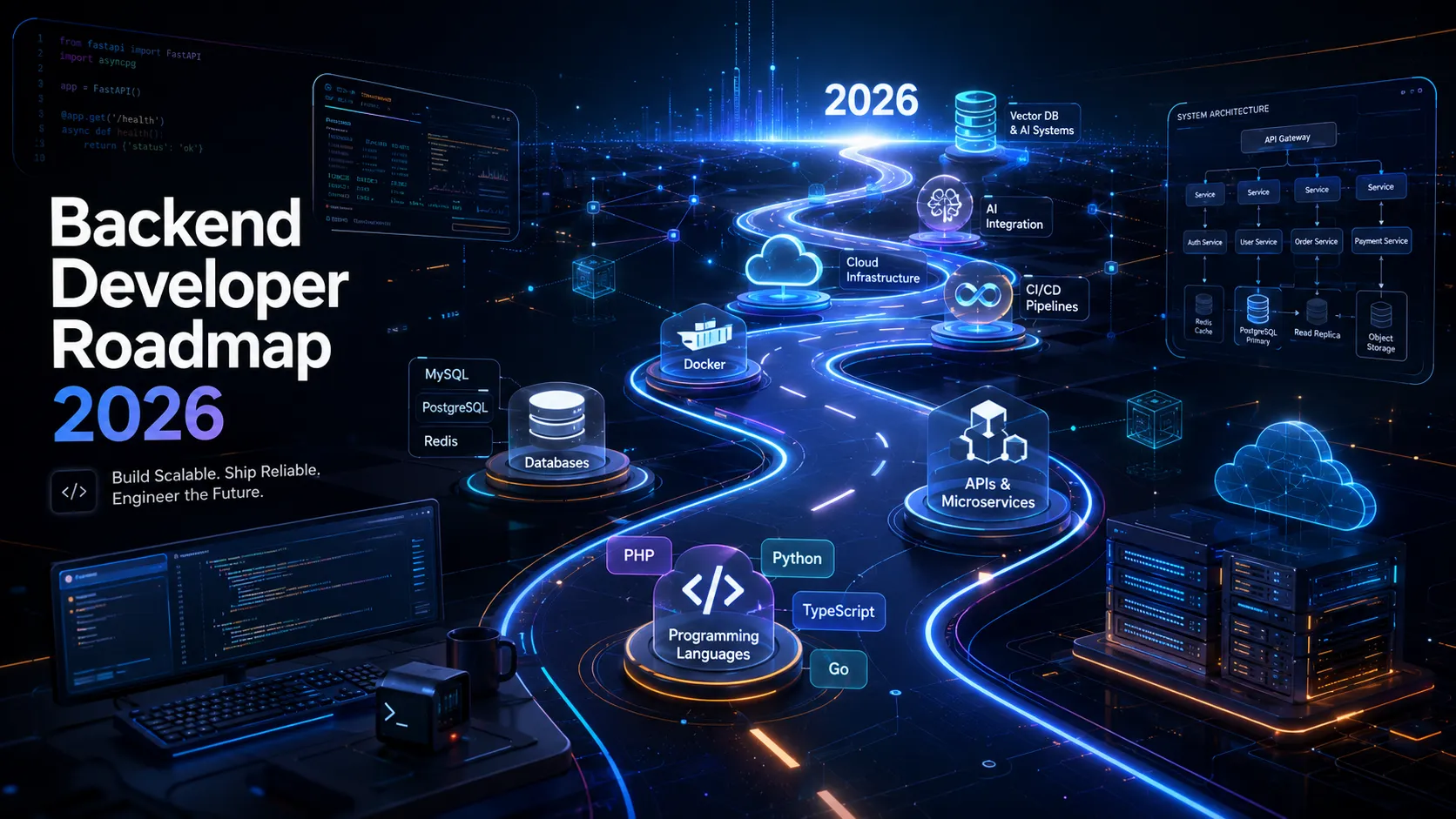
Backend development continues to evolve rapidly, and the skills required to become a successful backend engineer in 2026 are broader than ever. Modern backend developers are expected to build scalable APIs, work with cloud infrastructure, understand databases, automate deployments, and increasingly integrate AI-powered features into their applications.
The good news is that you don't need to learn everything at once.
In this roadmap, we'll explore the essential technologies and concepts every backend developer should learn in 2026, along with the recommended learning order.
1. Start With One Programming Language
| Technology / Skill | Priority in 2026 | Why It Matters |
|---|---|---|
| Programming Language (PHP, TS, Python) | Essential | The foundation of all backend development. |
| SQL Databases | Essential | Required for almost every production application. |
| Backend Frameworks | Essential | Speeds up development and provides best practices. |
| REST APIs | Essential | Most modern applications communicate through APIs. |
| Authentication & Security | Essential | Protects applications and user data. |
| Git & Collaboration | Essential | Standard workflow for professional teams. |
| Docker | Highly Recommended | Creates consistent development and deployment environments. |
| Redis & Caching | Highly Recommended | Improves performance and scalability. |
| Cloud & CI/CD | Highly Recommended | Necessary for deploying and maintaining applications. |
| GraphQL | Optional | Useful for complex frontend applications. |
| System Design | Advanced | Critical for senior-level backend roles. |
| AI Integration | Emerging Skill | Increasingly important for modern applications. |
The first step in becoming a backend developer is choosing a primary programming language.
There is no universally "best" language. The right choice depends on your goals, local job market, and personal preferences.
Popular backend languages in 2026 include:
- PHP (Laravel)
- JavaScript / TypeScript (Node.js, NestJS)
- Python (Django, FastAPI)
- Go
- Java (Spring Boot)
- C# (.NET)
For beginners, PHP with Laravel, TypeScript with NestJS, and Python with FastAPI are excellent starting points because they provide mature ecosystems and extensive learning resources.
The most important thing is not the language itself—it's learning programming fundamentals deeply.
2. Learn Core Programming Fundamentals
Before moving to frameworks, every backend developer should understand core programming concepts.
Focus on topics such as:
- Variables and data types
- Functions and classes
- Object-Oriented Programming (OOP)
- Error handling
- Design patterns
- SOLID principles
- Dependency Injection
Understanding these concepts will make learning frameworks significantly easier.
For example, if you understand Dependency Injection and interfaces, frameworks like Laravel or NestJS become much more intuitive.
3. Master Databases
Databases remain one of the most important skills for backend engineers.
Every developer should become comfortable working with relational databases such as:
- MySQL
- PostgreSQL
You should learn:
- SQL fundamentals
- Joins
- Indexes
- Transactions
- Normalization
- Query optimization
A simple API can work without optimization, but large-scale applications require efficient database design.
In addition to relational databases, learning a NoSQL solution such as MongoDB or Redis is highly recommended.
Redis, in particular, has become an essential tool for caching, queues, sessions, and performance optimization.
4. Learn a Modern Backend Framework
Once you're comfortable with programming fundamentals and databases, it's time to choose a framework.
Frameworks help developers build applications faster by providing solutions for routing, authentication, validation, caching, and more.
Popular backend frameworks in 2026 include:
- Laravel
- NestJS
- FastAPI
- Django
- Spring Boot
- ASP.NET Core
Frameworks should not replace your understanding of programming fundamentals. Instead, they should amplify your productivity.
Spend time understanding how your framework works internally rather than simply memorizing commands.
5. Learn API Development
Modern applications are increasingly API-driven.
Whether you're building web applications, mobile apps, SaaS platforms, or microservices, API development is a critical skill.
Every backend developer should understand:
- REST APIs
- JSON
- HTTP methods
- Authentication and authorization
- API versioning
- Rate limiting
- Error handling
You should also explore GraphQL, which continues to gain adoption for complex frontend applications.
Building APIs is one of the most practical ways to improve backend skills.
6. Authentication and Security
Security can no longer be treated as an optional skill.
Backend developers must understand how to secure applications and user data.
Key topics include:
- Authentication
- Authorization
- JWT
- OAuth 2.0
- Password hashing
- CSRF protection
- XSS prevention
- SQL Injection prevention
Ignoring security fundamentals can lead to severe vulnerabilities in production systems.
7. Learn Git and Collaboration Workflows
Modern software development is highly collaborative.
Every backend developer should know how to use Git confidently.
Important Git concepts include:
- Branching
- Pull Requests
- Rebasing
- Merging
- Conflict resolution
- GitFlow
Platforms such as GitHub and GitLab are now standard tools in professional development teams.
8. Learn Docker and Deployment
Writing code is only part of a backend developer's job.
You also need to know how to deploy and maintain applications.
Docker has become an industry-standard technology for creating consistent development and production environments.
You should learn:
- Docker fundamentals
- Docker Compose
- Environment variables
- Linux basics
- Nginx
- Reverse proxies
Understanding deployment pipelines will dramatically increase your value as a developer.
9. Understand Caching and Queues
Performance optimization becomes increasingly important as applications grow.
Modern backend systems frequently rely on:
- Redis
- Background jobs
- Message queues
- Caching layers
Learn when to use:
- Cache
- Queues
- Events
- Scheduled tasks
These concepts are essential for building scalable applications.
10. Learn Cloud and DevOps Basics
Backend developers are increasingly expected to understand infrastructure.
You don't need to become a full-time DevOps engineer, but you should be familiar with:
- AWS
- DigitalOcean
- Cloudflare
- CI/CD pipelines
- Monitoring
- Logging
Understanding how applications run in production will make you a better backend engineer.
11. Explore AI Integration
One of the biggest trends in 2026 is integrating AI capabilities into applications.
Modern backend developers should learn how to work with:
- LLM APIs
- Embeddings
- Semantic Search
- AI Agents
- Vector Databases
You don't need to become an AI engineer, but understanding how to integrate AI features will provide a significant competitive advantage.
Final Thoughts
| Language | Popular Framework | Best For | Difficulty |
|---|---|---|---|
| PHP | Laravel | SaaS, Web Applications, APIs | Beginner Friendly |
| TypeScript | NestJS | Enterprise APIs, Microservices | Medium |
| Python | Django, FastAPI | AI, APIs, Automation | Beginner Friendly |
| Go | Gin, Fiber | High-performance services | Medium |
| Java | Spring Boot | Enterprise systems | Advanced |
| C# | ASP.NET Core | Enterprise and Microsoft ecosystems | Medium |
Becoming a backend developer in 2026 is not about learning every technology available.
Instead, focus on mastering fundamentals, building real-world projects, and continuously improving your understanding of software architecture and system design.
Choose one language, learn one framework deeply, build projects consistently, and gradually expand your knowledge.
The developers who thrive in 2026 will be those who combine strong programming fundamentals with practical experience, scalability knowledge, and an understanding of modern cloud and AI-driven systems.